

Consider The Employee Experience of Every Department in Your Company for Optimal Success.
For a company to exist in the market with a relatively decent market presence, but yet, fail to capture a high market share, there could be a fault in the Employee Experience of one or more departments within the company.
For a company to exist in the market with a relatively decent market presence, but yet, fail to capture a high market share, there could be a fault in the Employee Experience of one or more departments within the company.
In conducting research on what makes companies successful, I discovered a misconception of having a great product to be the singular formula for success. It is certainly true that a great product creates value to satisfy the needs of the public or niche consumers. However, innovation that only thrives in one aspect of the company is incapable of solely preserving the longevity of a company’s financial health. Without focusing on revenue generation, the longevity of the brand’s value cannot be sustained; likewise without the brand’s value, the financial health of the company lies in jeopardy.
Thus, organizational success is the combination of innovation and generation in product(s) and revenue respectively.
It is common knowledge that organizations are made up of myriad departments (core and operational) each responsible for a unique function - Marketing, Sales, Design, IT, HR, Finance etc., that contributes to the growth and success of the company. Therefore, since every department has its own unique function within the company, every department and its incumbent employees, also has a unique need that needs to be addressed individually to satisfy the Employee Experience (EX) rule which states that, “how you treat your employees is reflected in how your employees treat your company and customers”.
Thus, the Employee Experience of your company is not a one size fits all strategy.
An error some companies suffer from is the overcompensation of the EX for their product design employees, while neglecting the EX of every other department in the company. This highlights the misconception of having a great product to be the sole formula for success. Aside from having a great product, the company also needs to ensure there is public awareness of the product, exceptional customer service, high return of investment, high employee engagement and performance standards, reliable logistics, high retained income, amongst other things.
If the Employee Experience of a company excludes the needs of these other teams, it inevitably will breed an army of disgruntled and unsatisfied employees incapable of performing at their optimal standards. It is based on such imbalance that a company can have high innovation in its product design, product value, product research but yet, have low public awareness, low market share, low inventory supply, poor customer service, poor employee performance, low assets, high liabilities, poor return of investment, etc. Although the company has a great product due to the great employee experience of its product design team, it will have a low - average revenue generation rate and market performance, because the employees responsible for driving sales, growth, customer service, marketing, investments and others, suffer from a lack or the absence of an experience that propels, motivates and equips them to connect to the company in order to perform at high standards.
The result of this wholistic approach to the EX of every department and its respective employee(s), ensures both it’s product innovation and revenue generation are operating at their optimum. Likewise, the shift in this approach to success allows the company to tackle the next phase which is, “How to design a unique Employee Experience for every department and its respective employee(s) in the company for Optimal Success”.

A Message to Emerging (Start Up) Companies
Value can be defined as a unique vision which breathes life into a company's existence. In the human world, people can be defined as inherent beings of creation. Translate this definition into the corporate world: you realize that employees are the inherent beings of creating value in businesses. Value is an important key to success.
The Effect of Strategic Talent Search on Selecting Your Target Audience:
Value can be defined as a unique vision which breathes life into a company's existence. In the human world, people can be defined as inherent beings of creation. Translate this definition into the corporate world: we can describe employees as inherent beings of creating value in businesses. Value is an important key to success.
Yet, would you agree that a significant number of companies are focused on making money first, rather than creating value; and thereby, are unable to select the appropriate target audience for their businesses? If this approach is re-defined to a focus on creating value first, it becomes apparent that companies are able to target the right audiences by strategically selecting individuals who are passionate about the company’s' vision and are adept at bringing the vision to life. These employees are equally capable of creating high quality and resonant products/+ services successfully aimed at targeting the right audience.
If you are interested in reading further, let's tie all of this into a seamless operation.
Step 1: Define your vision
Assess your vision and mission statements. Use this opportunity to dig in and discover the unique characteristic(s) that define your company's value proposition. Case Example: Interior Design/Architectural Firm. As simple as it sounds, its a diverse industry specializing in the areas of residential, commercial, luxury, contemporary, modern, cultural, structural (et al) design. For this particular firm, by narrowing down it's vision to it's areas of expertise, it is able to select the areas of specialization that correspond with it's vision, and thereby, design a system that translates this vision into products that create value.
Step 2: Define your talent
This step defines all the jobs vital to translating the company's vision into products. Jobs in a workplace can be divided into the following sections: core, operational, fixed and contingent jobs. Employees, the people essential to performing these jobs, can also grouped into the 4 areas- core, operational, fixed and continent employees. Your core employees provide the required skills to perform jobs essential to translating your vision into a product. Your operational employees ensure their jobs sustain the continuance and growth of your company. Some employees might be required to work on permanent jobs, while others are needed on a flexible/per project basis- fixed and flexible employees respectively. You might need all four types of these employees/jobs to create value in your company, or you might need just one. The important thing is to ensure you consider all the jobs in the design system of translating your vision into products, and account for the corresponding type(s) of employees to perform each job.
Step 3: Define your target audience
Following the example in step 1 for the Interior Design/Architectural firm: in this step, the company has selected it's areas of expertise and is now able to choose its audience to allow it provide high quality and resonant work that is tailored to it's customers' preferences.
If the Interior Design/Architecture firm chooses to focus on modern and structural interior design, it's customers will appreciate work like this:

SOURCE: Studio PMK + Designers
If the Interior Design/Architecture firm chooses to focus on modern and structural workplace design, it's customers will appreciate work like these:


SOURCE: West Elm Corporate Headquarters
Step 4: Recruit your employees:
Once you have successfully divided your jobs into either core, operational, fixed or flexible employees, you are able to search in the various talent pools for qualified employees to perform each job.
I personally believe a visual approach is highly effective at recruiting core employees in the Interior Design/Architecture firm as human beings have a deeper and resonant connection to visuals- as the saying goes: "pictures speak louder than words". Notwithstanding, the firm's recruitment strategy will look like this:
1. Employees:
Core Employees: Interior Designers, Architects and Visualization Technicians etc.
Operational Employees: Project Managers, Marketing Coordinators and Human Resources Professionals etc.
2. Type of Work:
Fixed Jobs: Hourly/Salaried employees, Managers, Executives etc.
Contingent Jobs: Consultants, Auditors, Contractors etc.
3. Hiring Techniques:
Visual Approach: this includes, Portfolios, Websites and Case Study Tests to assess patterns, colours, lighting choices etc.
Structured Interview Approach: Interview questions targeted at guaging candidates' interest in the value proposition & design approach. In the case of operational employees for example, the company's interview questions can focus on the company's collaborative culture, the theme and structure of it's workplace design and the candidates' ability to significantly impact and assist its core jobs and employees to yield value to its target audience etc.
As always, build an employee experience design that mirrors your business requirements and mirrors the expectations of your employees to ensure a high retention rate and continuous production of high quality work.
Strategic talent search creates an excellent opportunity for a company to define all the jobs required to translate it's vision into a product, thereby creating value. It creates an opportunity for it's employees to organically connect with the company's vision, communicate the company's value proposition to it's customers, while maintaining healthy relationships with them. This dynamic combination inevitabily generates money for the company!

Let's Reconsider the Candidate Experience
A candidate's experience when applying for job(s) in your company is a yardstick to measure your commitment to employee experience.
A candidate's experience when applying for job(s) in your company is a yardstick to measure your commitment to employee experience. As candidates become more strategic in their approach to job search, time will become a valuable commodity. Candidates will no longer be subjected to lengthy, redundant and obsolete application processes. They will be interested in applying for jobs in a system that is simple, guided and clearly encourages them to complete the job application process from start to finish.
The candidate experience is a key element of your employer brand.
A company that claims to be innovative and employee focused must ensure it's candidate experience is reflective of it's mission. So, what does this mean for you? Know your audience! Your potential future employees must be be able to trust your claim & a beautiful way to prove your commitment to their experience is ensuring your job application process is innovative, simple & employee experience focused.
Career Website:
The first point of contact for the job application process is the career website. This is where the elements of "visual design" and "user experience" come into play. Research shows that humans are attracted to things and people they find aesthetically pleasing. Likewise, humans are able to trust things and people they find attractive. The visual design of the career website can make a difference in candidates' perception of the company. In addition, if candidates have a good experience with a career website, it is logical to assume that they will trust the company and proceed with their job application from start to finish.
Let's Analyze the Steps Involved in the Job Application Process
Step 1: Focus on the Visual Design
The career website should be filled with engaging media that showcase what it's like to work for your company. This is an excellent opportunity for you to include pictures and videos of your workplace design, diversified culture, employee reviews, company activities and company benefits. Be sure to use captivating words and fonts that are aesthetically pleasing to your audience. Collaborate with your UX design team to craft a career website that is sleek, simple, modern and user experience friendly.
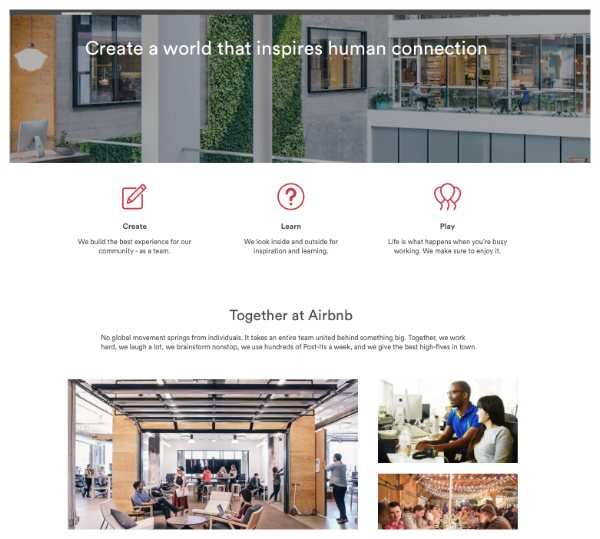
Source: Airbnb
Step 2: Organize Job Postings
The frustration from searching for jobs via "keywords" or "locations" tops no other. It operates on the assumption that candidates are knowledgeable of your organizational structure i.e. the number and types of departments an organization has & the locations it operates in. By focusing on the candidate experience, you can simplify the search experience for candidates by organizing job postings according to these two categories -departments & locations.
While this step focuses on the candidate experience from the perspective of job applications via career websites, it is important to know that some candidates are more inclined to search for jobs via social media & job boards. For such candidates, you can choose to include a direct application link on the job board postings to eliminate redundancies in the application process.
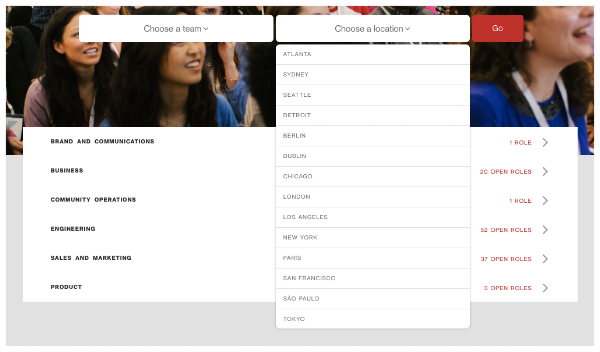
Source: Pinterest
Step 3: Simplify Job Descriptions
The most important thing in this step is to ensure the job posting contains the most recent version of the job description. An outdated job description will affect the candidate's future employee experience as there will be discrepancies in the employee's expectations vs actual reality.
Secondly, it is important to eliminate "noise" in the job description. An effective job description should be simple, brief and straight to the point. As mentioned earlier, time is a valuable commodity for candidates who engage in strategic job search. So we want to use compelling words while arranging information in a simple and concise manner. Information such as company benefits, that have been included in the career home page can be excluded from the job description.
Finally, I believe it is important to pay attention to the words used in the job description as they can affect the candidate's perception of their ability to perform the job. Words such as "manage, handle, ensure & engage" provide a sense of autonomy to candidates while words such as "required or responsible" create a sense of anxiety & tension in performing the job.
An effective job description should include:
a brief description of your company and/or department goals
the main reason why the job position is required
how the job will contribute to achieving your overall company and/or department goals
the main job responsibilities
most relevant job qualifications
job location
any relevant disclaimers **
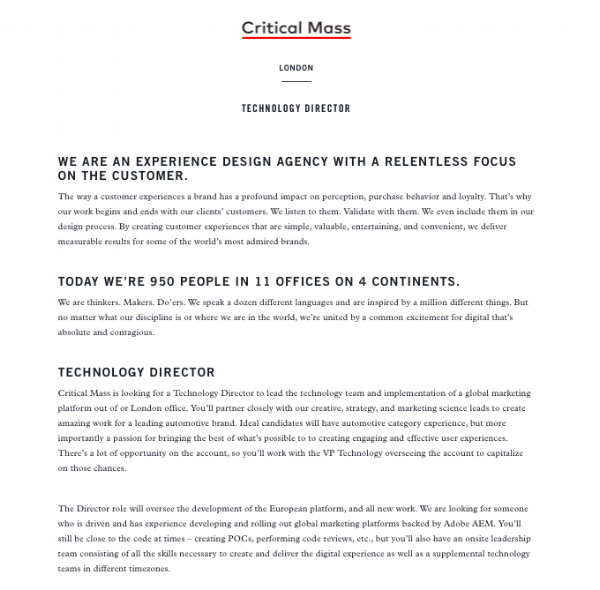

Source: Critical Mass
Step 4: Don't Ignore the User Experience
The concept of reconsidering the candidate experience involves removing redundancies in the job application process. In an ideal world, I believe candidates would prefer a system that tears down the "sign-in/register" barrier. Candidates would rather complete their application by filling in their contact information, uploading their resume and/or cover letter and then click the submit button in one page. I have titled this the "one-page submission". An example is shown below:
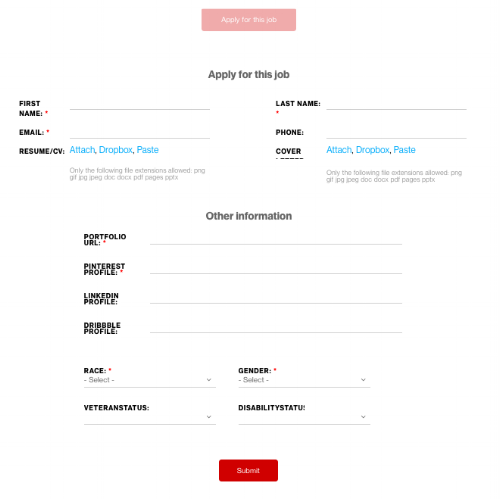
Source: Pinterest
However, due to system configurations, legal & security reasons this option is not viable to every company. So I asked myself, how then can we provide a rationale to candidates explaining the importance of registry in the job application process? include a disclaimer on the implication of "new user registration". This way, candidates have a clear understanding of the requirement(s) and can proceed with their job application with little to no frustration.
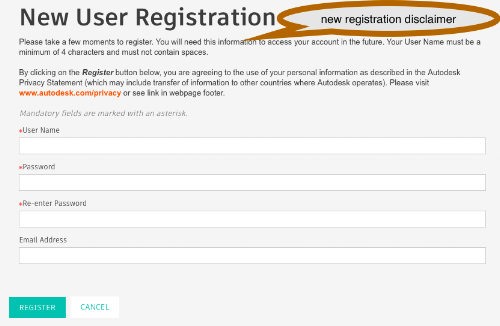
Source: Autodesk
For companies who choose to proceed with this method: it is important to note that the candidate experience shouldn't stop at the registration process. Simplicity and a friendly user experience should continue until the final submit button.
I played around with Cisco's job application system to test it's user experience via the registration process. In Cisco's system, candidates are required to create a profile when they register. The following information was requested: Contact, Education, Work History & Resume. Once this information is uploaded it is stored in the candidate's profile. Therefore, if a candidate chooses to apply to a new job at a later date, the candidate simply clicks on the apply button, logs in and is directed to a final submission page to complete the job application process. This brings us back to the simplified one-page submission process. (A disclaimer on editing your profile should be provided to candidates as a reminder to use their most relevant information when submitting their application).
By combining the features of the one-page submission & disclaimers you will provide a simplified and transparent job application process to your candidates.
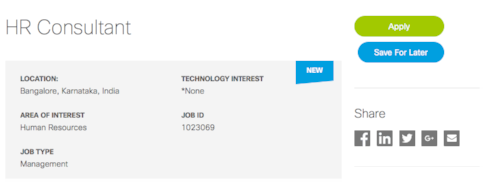
Source: Cisco

Source: Cisco
Step 5: Include a Progress Indicator
If we look into the online shopping experience we notice that companies provide customers with updates on their orders for each purchase. Customers receive a thank you/order received confirmation email, followed by a shipping confirmation email and finally, a delivery confirmation email. This logic can be applied to the job application process.
You can utilize the Applicant Tracking Systems (ATS) to inform candidates of your decision(s) for each step of the application process. Keeping applicants informed of each step of the application process provides transparency to the applicants- a key element of the employee experience. If the future of work encourages strategic job search, it is logical to assume candidates will be selective with their job applications. So let's not waste these applicants time if we decide not to move ahead with their application. A simple rejection email to an applicant goes a long way in the candidate experience. This way applicants can easily move on with their job search rather than operate on assumptions.

Source: jazzhr
Step 6: Kickstart the Employee Experience
Once you've conducted interviews, negotiated salaries and made your final offer to your selected candidate, the on-boarding process begins. Now the candidate transitions into an employee. Ensure there is consistency in the candidate experience and the employee experience.
Conclusion: The candidate experience provides an excellent opportunity for companies to put their best foot forward in regards to employer branding. Yet, we see many organizations ignoring the candidate experience in the hiring phase. Looking at the customer experience for online shopping, organizations are taking measures to ensure customers do not drop-off at any stage in the shopping experience. The same effort can and should be applied to the candidate experience.
As companies focus on these steps, a strong message of commitment to the candidate & employee experience is sent to potential employees. You attract the best talent by convincing them that you are the best company to work for!

The Future of Work & Strategic Job Search
The concept of the future of work creates workplace ecosystems of talented & motivated employees who perform at their best because there's a connection to the work that they do. A connection that taps into self accomplishment, passion & autonomy.
The concept of the future of work creates workplace ecosystems of talented & motivated employees who perform at their best because there's a connection to the work that they do. A connection that taps into self accomplishment, passion & autonomy.
As organizations begin to embrace employee expectations, employees will opt to work in workplaces of their choice. There will be a shift in competition in the job market. Rather than a primary focus on compensation, employees will become strategic in their job search & also to look into these areas: companies' mission statements, commitment to employees expectations, word of mouth & social media. On the other hand, HR functions like recruitment will equally benefit from a significant noise reduction in screening talent pools.
Mission Statement:
A company's mission statement = a company's passion. The mission statement highlights a company's fixed areas of interest on its journey to success. Thus, as a candidate, a simple way to tap into what a company is about is by reading their mission statement. As an employee experience designer & happiness enthusiast, some mission statements that resonate with me are:
Happiness as a lifestyle:
"Our mission: to inspire and nurture the human spirit – one person, one cup and one neighborhood at a time." -Starbucks
Let's make a better world:
"is to help people imagine, design, and create a better world. Autodesk's mission is to build software tools to enable people to experience their ideas before they are real." -Autodesk
Employees are welcome too:
"Shape the future of the Internet by creating unprecedented value and opportunity for our customers, employees, investors, and ecosystem partners." -Cisco
Employee experience impacts customer service:
"We will be the Best Run, Customer-Focused, Integrated Financial Institution, with a Unique and Inclusive Employee Culture." -TD Bank
Commitment to Employees' Expectations:
Thanks to the internet & technology, we are able to easily access information on companies via their websites, professional blogs, social media etc. Some companies like Cisco are taking it a step further by encouraging employee blogs on their company website. These blogs allow employees share their employee & personal experiences with their peers & the public. Likewise, the public & job seekers are provided with first hand information on what it's like to work for the company.
Word of Mouth & Social Media:
Companies such as Glassdoor are providing platforms for employees to share their insights on the workplace experience - the best part of it, it's reliable! My best friend recently got hired at Autodesk & she's always excited to share her workplace experience with me because it embraces her expectations of a workplace. Autodesk is rated 4.4 out of 5 on Glassdoor. James Morgan, creator of the Employee Experience Index, also ranks Autodesk as a top company for employee experience. There's consistency in the reviews.
As the future of work encourages strategic job search, companies will benefit from a myriad of qualified, talented, passionate & aligned employees who share the common goal of creating products & services to satisfy their customers & inspire happiness in the world.
Job search can be strategic too!

Let's Dig Into the Employee Experience
As we embrace the shift in the workforce, it is important to address the gap between employee expectations & the employee experience. Questions should be asked & behaviours observed.
As we embrace the shift in the workforce, it is important to address the gap between employee expectations & the employee experience. Questions should be asked & behaviours observed.
In a time where money is not the primary factor of employee retention, focusing on the employee experience will make the difference in organizations' success.
Here are some questions to start the discussion:
Are you experiencing a high employee turnover?
Is the quality of work produced by employees matching your business requirements?
Are your employees connected to your customers?
Do your customers feel the sense of purpose in their interactions with your employees?
How will you define your employee branding? Do your employees vouch for your organization outside of work?
Do you use people analytics to infer employee trends & monitor satisfaction rates?
Do you use people analytics to make informed decisions on your employees?
Are your employees innovating?
Who suggests new ideas in the organization? Is innovation limited to top-management only? Are employees engaged in innovation across the organization?
Are your employees comfortable with relating to your upper management?
As we begin to probe into these questions, we start digging into the employe experience and get a bigger picture of the connection between employees, customers and the organization.
Happy digging!